
That observation — from José Andrés González, a journalist at Caracol Radio — gets to the heart of one of Latin America’s most pressing challenges: corrosive capital®. Foreign investment that enters countries by sidestepping legal frameworks, undermining institutions, and weakening democratic governance often does so quietly, through opaque contracts, regulatory loopholes, and elite capture. It is hiding in the open.
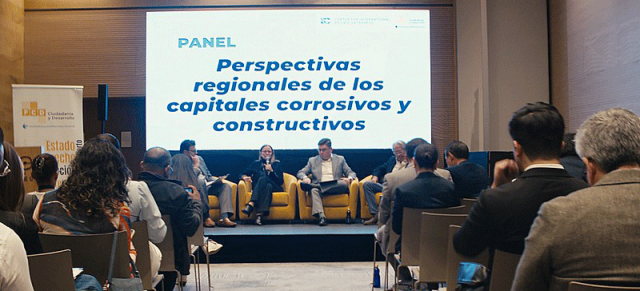 Exposing it requires journalists with the right tools, researchers with rigorous methodologies, and institutions with the political will to act. Constructive Capital Week, held June 29-July 3 in Quito, Ecuador, brought all three together.
Ecuador at a Foreign Investment Crossroads
Ecuador sits at a crossroads. Like many countries in Latin America, it is actively seeking new sources of foreign investment to drive development — particularly in its mining sector. But not all investment is created equal. Without strong transparency standards, legal certainty, and robust institutional oversight, capital flows can erode rather than strengthen economies.
Against this backdrop, CIPE convened partners, journalists, and representatives from Ecuador’s public and private sectors to advance a regional agenda built on a simple premise: investment should contribute to prosperity, not undermine it.
Vital Steps to Fight Corrosive Capital
Event highlights:
- Researchers from Fundación Milenio (Bolivia) presented the Constructive Capital Index, a rigorous methodology for evaluating the performance and integrity of foreign companies operating in the region.
- CIPE partner Fundación Ciudadanía y Desarrollo (FCD) launched its new report, Mining in Ecuador: Investment and Development Through Constructive Capital, offering an in-depth look at how Ecuador can attract responsible investment in one of its most critical sectors.
- The event also marked the official launch of Ecuador’s Observatory for Development and Investment, a new platform designed to track capital flows and promote accountability in the country’s investment environment.
In addition, 10 journalists from six Latin American countries completed specialized training designed to sharpen their ability to identify, investigate, and report on corrosive capital.
“This training provides me with the tools to explore whether cases of corrosive capital are emerging in Colombia,” said Juan David Pérez of La Silla Vacía, Colombia’s independent investigative outlet. “I now have more resources to investigate these issues and bring them to public attention.”
González, whose outlet Caracol Radio is part of Grupo Prisa and a long-standing CIPE ally, put it plainly: “This course provided us with a set of tools to broaden our perspective and strengthen journalism’s role in oversight and accountability.”
Seven Years in the Making
CIPE’s work on corrosive capital in Latin America dates to 2017. According to Martin Friedl, CIPE’s Regional Director for Latin America and the Caribbean, the organization first examined how major investments — particularly those from China — entered Argentina by circumventing national regulations. That case study opened a wider inquiry.
Since then, CIPE has built a body of comparative research to map the institutional gaps that allow foreign capital to erode economies and weaken democratic governance across the region. Alongside that research, the organization has developed practical recommendations: how to strengthen transparency frameworks, how to build the conditions for healthy foreign investment, and how to make economic resilience a structural feature of democratic governance — not an afterthought.
Building the Architecture for Accountable Investment
For Mauricio Alarcón Salvador, Executive Director of FCD, initiatives like Constructive Capital Week are essential precisely because the problem is multisectoral. No single ministry, newsroom, or civil society group can counter corrosive capital alone. “We need to chart a roadmap,” he said, “to ensure that investments effectively contribute to the development of countries across the region and the Western Hemisphere.”
That roadmap is taking shape. Through research, public dialogue, journalist training, and the launch of new monitoring institutions like Ecuador’s Observatory for Development and Investment, a regional ecosystem is emerging — one built on transparency, integrity, and the understanding that democratic governance and economic resilience are inseparable.
CIPE will continue supporting those efforts. The journalists trained in Quito will return to their countries with new tools. The Observatory will begin tracking. The index will inform policy. And the conversation — about what kind of capital Latin America wants, and what it should demand from those who bring it — will continue.
Constructive Capital Week was organized by CIPE in partnership with FCD (Ecuador).
Published Date: July 21, 2026